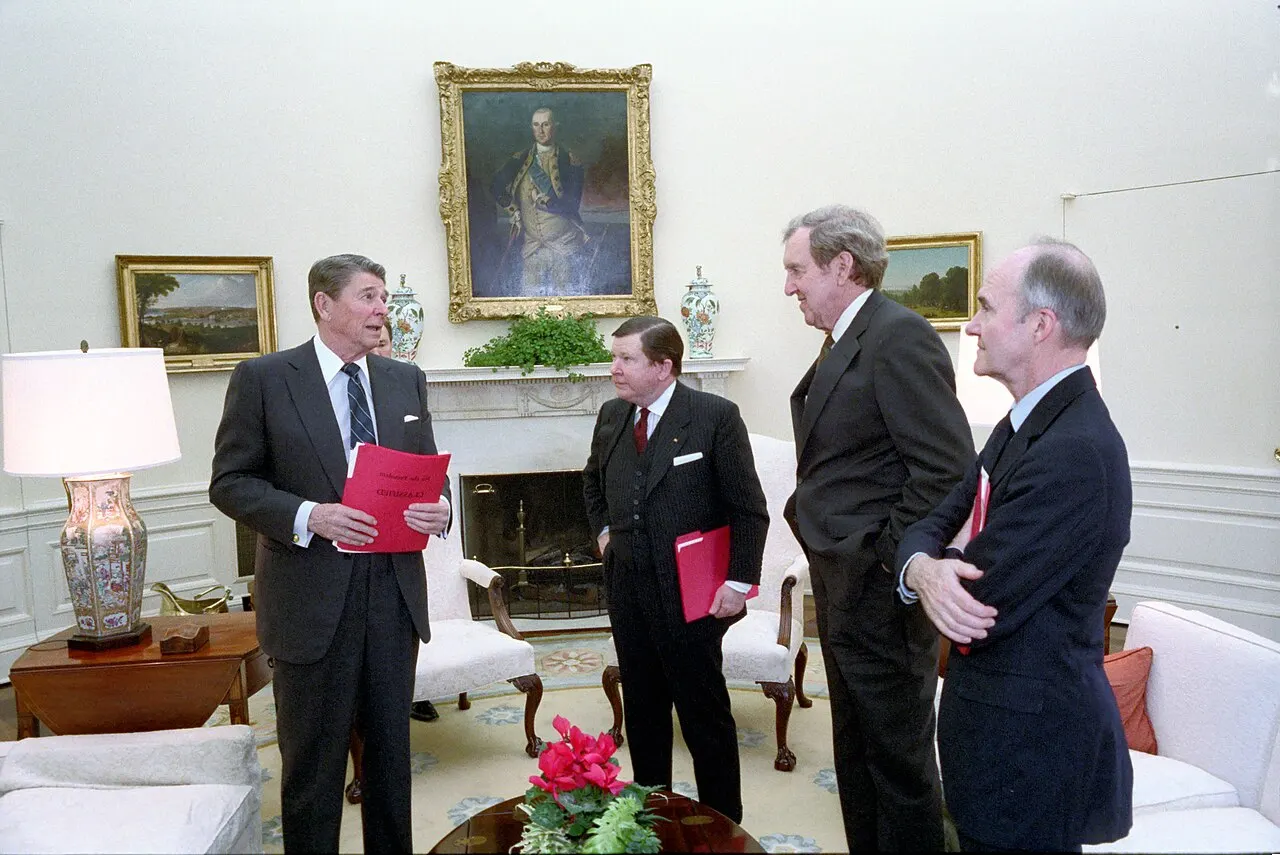
Forty years ago this week, on November 25, 1986, Attorney General Edwin Meese stood beside President Ronald Reagan and revealed that profits from secret US arms sales to Iran had been diverted to the Contra rebels in Nicaragua. It was the moment the Iran-Contra affair became the biggest scandal of Reagan’s presidency.
To mark the anniversary, the National Security Archive, a nonprofit research center at George Washington University that obtains government records through the Freedom of Information Act, published a collection of 12 key Iran-Contra documents on November 18, 2026. The collection, Electronic Briefing Book No. 936, was edited by Malcolm Byrne, Peter Kornbluh and Tom Blanton.
The Archive presents it as a selection of documents to remember the scandal. It does not describe the documents as newly declassified. What it offers is a short guided tour of the record, from the planning in 1984 to the legal debates of 1991.
What is in the collection
The 12 documents span seven years. Among the highlights:
A 1984 warning about “impeachable” funding. Minutes of a National Security Planning Group meeting on Central America, dated June 25, 1984, record a discussion of getting other countries to fund the Contras. According to the minutes, Secretary of State George Shultz cited White House Chief of Staff James Baker’s view that such third-country funding could be “an impeachable offense.” Vice President George H. W. Bush disagreed.
A memo that North later rewrote. A March 16, 1985 memo from Oliver North to National Security Adviser Robert McFarlane laid out a “fallback plan” to keep the Contras going if Congress refused funds, including approaching donors such as Saudi Arabia. The Archive posts both the original and a version North altered in November 1986. According to the Archive, he was caught because the altered version used a letterhead that was not in use in early 1985.
The “Diversion Memo.” North’s April 4, 1986 memo on the release of American hostages in Beirut proposed using “residuals” from the arms sales to fund the Contras. Justice Department investigators found it in late November 1986. The Archive notes that, for unknown reasons, it escaped North’s document “shredding party.”
Diaries and notes from the top. The collection includes an entry from Defense Secretary Caspar Weinberger’s diary from December 1985, and a November 1986 excerpt from Bush’s own diary, in which he wrote that he was one of the few people who knew “fully the details.” It also includes notes from Shultz’s aide Charles Hill, dated November 9, 1986, quoting Shultz: “We have assaulted our own MidEast policy.” The Archive says most of Hill’s several thousand pages of notes have never been declassified.
Deals with foreign governments. A 1989 government stipulation filed in court summarizes arrangements with countries including Honduras, Guatemala, Panama, Israel and Saudi Arabia. According to that document, Saudi Arabia contributed $32 million to the Contra effort.
Could the president be charged? Two memos written for Independent Counsel Lawrence Walsh on March 21, 1991, examine the possible criminal liability of Reagan and of Bush, by then president. The memo on Reagan found no basis for a criminal prosecution, while calling the arms-sales question a “close legal call.”
Why it still matters, according to the Archive
The Archive’s editors frame Iran-Contra as an attempt by the Reagan White House to get around the powers the Constitution gives Congress over money and war. Archive director Tom Blanton is quoted in the posting: “Forty years later, that dark and complex history continues to provide relevant lessons.”
The story ended without a full legal reckoning. Fourteen people were charged, but the convictions of North and Poindexter were overturned on appeal, and on Christmas Eve 1992 President Bush pardoned six others, including Weinberger. Walsh’s office said the pardons meant the cover-up had been “completed.”
What this proves, and what it does not
The collection shows, in the officials’ own words, that the Contra funding was discussed at the highest level from 1984, that a written plan for the diversion existed, and that key records were altered or destroyed when the scandal broke.
It does not prove that Reagan knew about the diversion of funds. No investigation established that, and the 1991 memo written for Walsh found no basis for prosecuting him. Some passages in the posting, such as its view on how much Bush knew, are the editors’ interpretation rather than a finding of the courts. Readers can judge for themselves: the documents are linked from the Archive’s page.
Sources
- National Security Archive, Iran-Contra Scandal Marks 40th Anniversary, Electronic Briefing Book No. 936, ed. Malcolm Byrne, Peter Kornbluh and Tom Blanton, November 18, 2026.
- NPR, George H.W. Bush’s Mixed Legacy In A Reagan-Era Scandal, December 6, 2018.
- Lawrence E. Walsh, Final Report of the Independent Counsel for Iran/Contra Matters, US Court of Appeals for the District of Columbia Circuit, 1993.