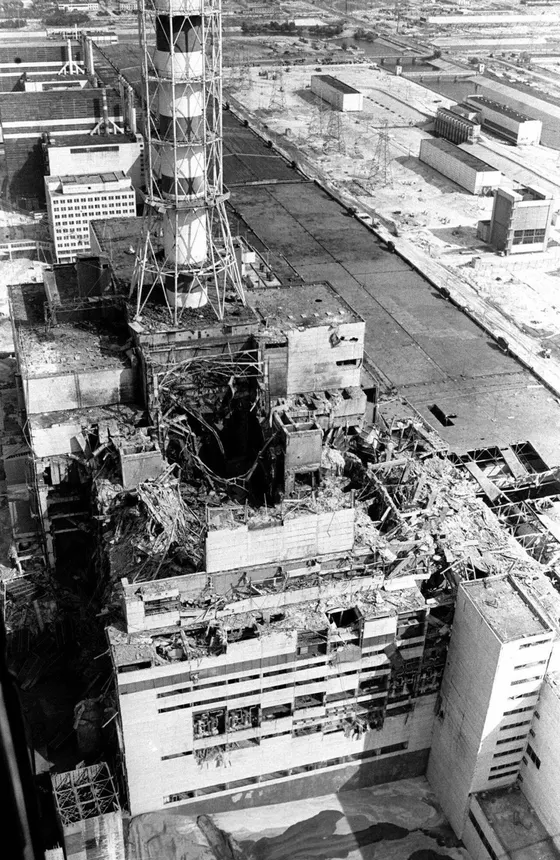
In the early hours of 26 April 1986, reactor No. 4 at the Chernobyl nuclear power plant, in Soviet Ukraine, blew apart during a safety test. Fire and radioactive material poured into the night sky.
Within hours, the local branch of the KGB, the Soviet secret police, was writing reports. Its officers counted radiation levels, tracked the mood of the population and watched foreign visitors. A few weeks later, a classification order made almost everything about the accident a state secret.
For decades, those reports sat in the archive of the Ukrainian KGB in Kyiv. After the Soviet Union collapsed, the archive passed to Ukraine’s Security Service, the SBU. Since 2016, Ukraine has declassified and published hundreds of these pages. They tell a story that begins long before the explosion, and they show how much the Soviet state knew, and chose to keep quiet.
A plant built in a hurry
Construction of the Chernobyl plant began in the early 1970s, near the new town of Pripyat, north of Kyiv and close to the border with Belarus. It used the RBMK, a large Soviet reactor design cooled by water and moderated by graphite.
The KGB watched the project from the start. Its job was not only to catch spies but to report on anything that could embarrass or endanger the state, including sloppy work on strategic sites.
The earliest documents in the declassified files date from 1973. In a memo of 2 April 1973, the head of the KGB in the Kiev region reported violations in reinforcement and concrete work at the construction site. A July 1973 memo blamed some of the defects on the poor work of a rebar workshop.
In December 1978, the Chernobyl district KGB office sent a report titled “Information about Violations in the Construction of the Chernobyl Atomic Energy Station.” It listed breaches of technical norms and labor rules, and warned that some defects could, in the future, let groundwater seep into the building.
These were not secret revelations hidden from the leadership. They were sent up the chain of command. Yet construction went ahead, and the plant’s first unit was connected to the grid in the late 1970s.
The accidents before the accident
The most striking documents concern incidents at Chernobyl in the years before 1986.
On 9 September 1982, during the restart of Unit 1 after scheduled maintenance, a fuel channel inside the reactor ruptured as power was being raised. KGB reports from that month describe the emergency shutdown. When the SBU released documents in April 2021, it summarized one of them in blunt terms: “In 1982, a significant release of radioactive substances occurred at the first power unit.”
The KGB report on that incident, according to the SBU, ended by noting that measures had been taken “to prevent panic and provocative rumors.” The public was not told.
In 1984, according to the SBU and a KGB report dated 1 March 1984, there were emergency situations at Units 3 and 4. The report mentions violations in reactor design and disintegrating concrete. Other KGB reports that year described faulty pipe joints and a lack of reactor reliability. As AFP summarized it in 2021, Ukrainian officials said the Soviet Union knew the plant was dangerous and covered up emergencies there before 1986.
“One of the most dangerous” plants
The KGB’s concern was not limited to Ukraine. On 20 May 1983, a colonel in the Moscow KGB, A. I. Samoilov, wrote a report on design weaknesses in Soviet nuclear power plants. It concluded that the Leningrad, Kursk and Chernobyl plants, all using RBMK reactors, were dangerous.
As summarized by the SBU in 2021, Moscow had been told that Chernobyl was “one of the most dangerous nuclear power plants in the USSR,” because of a lack of safety equipment.
That warning reached the capital nearly three years before the explosion. It did not lead to the changes that might have prevented it.
The night of 26 April 1986
The explosion came during a test of whether the turbines could keep power flowing to the cooling pumps in a blackout. A combination of design flaws in the RBMK reactor and operator actions caused a sudden power surge, according to the International Atomic Energy Agency (IAEA). Two explosions destroyed the reactor and set the graphite on fire.
According to the United Nations Scientific Committee on the Effects of Atomic Radiation (UNSCEAR), two plant workers died that night. Twenty-eight more, mostly firefighters and plant staff, died of acute radiation sickness within months.
Among the documents released in 2021 was the first written report on the explosion by the plant’s director, Viktor Bryukhanov, and records of the conversations between plant operators that night. Bryukhanov was later tried and sentenced to ten years in a labor camp.
The KGB went to work immediately. A secret, urgent report from the Kiev city and regional KGB on 26 April 1986 laid out a first chronology. Reports over the following days tracked radiation readings, the evacuation and the condition of the first victims.
According to the Wilson Center’s history of the documents, the evacuation of Pripyat required more than 1,100 buses. The town, home to about 49,000 people, was emptied on 27 April, roughly 36 hours after the explosion.
Watching the people
Many of the KGB’s reports are about public opinion. Officers listened to what people said in shops, taxis and workplaces, and passed it on.
A report from the end of April recorded a Kyiv taxi driver saying that “the water in the Dnepr was completely contaminated.” Another, in May, noted that some truck drivers refused to drive near the plant. A report dated 8 May 1986 describes measures to stop foreign journalists from gathering information in the evacuation areas.
According to the SBU, by 27 April the KGB had begun compiling a list of “unreliable” Pripyat residents and foreign delegations. Later reports described efforts to stop Ukrainian “nationalists” from obtaining contaminated soil samples.
One episode from 1987 stands out. According to the SBU, in October 1987 a French journalist tried to take soil and water samples from the area out of the country, and the KGB quietly replaced them with clean ones. This account comes from the SBU’s summary of a KGB report; it has not been independently confirmed.
The world finds out from Sweden
The Soviet government said nothing at first. On the morning of 28 April, workers at the Forsmark nuclear plant in Sweden, more than 1,000 kilometers away, set off radiation alarms. When they realized the contamination was not coming from their own plant, Sweden began asking questions.
That evening, the Soviet news agency TASS released a short statement acknowledging an accident. Mikhail Gorbachev did not speak about it on television until 14 May 1986, more than two weeks later. The IAEA was officially notified on 30 April.
Classifying the truth
On 8 July 1986, an order titled “Inventory of Information Subject to Classification” was issued for the Unit 4 accident. It listed what could no longer be made public: the causes of the accident, the nature of the destruction, the radiation situation, the scale of the cleanup and the number of people who fell ill.
According to historian Adam Higginbotham, writing for the Wilson Center, the list covered 26 topics. The first item, marked “secret,” was information revealing “the true reasons for the accident.”
In August 1986, the chairman of the USSR KGB signed an order to strengthen counterintelligence work at nuclear plants across the country. Other KGB reports that summer complained about the misuse of soldiers in the cleanup and about contaminated food.
Officially, the Soviet Union blamed the operators. That account was later revised. In 1992, an IAEA safety group concluded that design flaws in the RBMK reactor, especially the design of its control rods, had played a major role.
How the files came out
The Soviet Union collapsed in 1991, and Ukraine inherited the archive of the Ukrainian KGB. In 2015, Ukraine passed a law opening the records of the Soviet security services to the public.
In 2016, for the 30th anniversary of the disaster, a set of KGB documents on Chernobyl was declassified and published online by the Ukrainian Center for Research on the Liberation Movement. In 2019, the Wilson Center in Washington published English translations of 28 of them, covering 1973 to 1991.
On 26 April 2021, the 35th anniversary, the SBU released another batch, along with the documentary collection The KGB Chornobyl Dossier: From Construction to the Accident, prepared with the Ukrainian Institute of National Memory and the Institute of History of Ukraine. It contains 229 documents, most published for the first time.
The last document in the Wilson Center’s set is a January 1991 report by a commission of the Ukrainian parliament. It estimated that about 4.5 million people in Ukraine, Belarus and Russia lived in the area potentially affected by the accident.
The legacy
The declassified files do not change what happened inside reactor No. 4. What they change is the context. They show a state that knew its flagship plant was badly built, that had seen accidents there before, and whose first instinct after each one was to keep it quiet.
The disaster itself became a turning point. Gorbachev later wrote that Chernobyl was perhaps the real cause of the Soviet Union’s collapse. Whatever the weight of that claim, the KGB’s own paper trail shows how secrecy turned a technical failure into a political one.
Myths and facts
| Claim | What the evidence says |
|---|---|
| The KGB warned about problems at Chernobyl before 1986 | True. Reports from 1973, 1978, 1983 and 1984 describe construction defects, unsafe design and accidents. |
| There were no accidents at Chernobyl before 1986 | False. KGB files document a 1982 fuel channel rupture at Unit 1 and emergencies at Units 3 and 4 in 1984. |
| The Soviet Union announced the disaster right away | False. The first brief TASS statement came on 28 April, after Swedish detectors picked up radiation. |
| The causes of the accident were officially classified | True. An 8 July 1986 inventory made the “true reasons for the accident” secret. |
| The KGB swapped a French journalist’s contaminated samples | Reported. The claim comes from the SBU’s summary of a KGB report and has not been independently confirmed. |
| The disaster was caused only by operator error | False. The IAEA’s 1992 review found that reactor design flaws played a major role. |
Sources
- Wilson Center, Sources and Methods, 28 Newly Translated Documents on Chernobyl, 1973-1991, September 2019.
- Adam Higginbotham, Wilson Center, “An Explosion Occurred in Power Unit No. 4”: The Story of Chernobyl in Documents, April 2019.
- Wilson Center Digital Archive, Report from the Kiev City and Kiev Oblast KGB Administration, 26 April 1986 (HDA SBU).
- Kyiv Post / Interfax-Ukraine, SBU releases part of classified documents about Chornobyl disaster, 26 April 2021.
- AFP via Asharq Al-Awsat, Unsealed Soviet Archives Reveal Cover-ups at Chernobyl Plant Before Disaster, 26 April 2021.
- Security Service of Ukraine (SBU), Sectoral State Archive, SSU Archive declassified details of construction and Chornobyl disaster.
- SBU Archive and Ukrainian Institute of National Memory, The KGB Chornobyl Dossier: From Construction to the Accident.
- International Atomic Energy Agency, Frequently Asked Chernobyl Questions.
- International Atomic Energy Agency, INSAG-7: The Chernobyl Accident, Updating of INSAG-1, 1992.
- World Nuclear Association, Chernobyl Accident 1986.
- UNSCEAR, Sources and Effects of Ionizing Radiation, Annex D: Health effects due to radiation from the Chernobyl accident, 2008.
- Adam Higginbotham, Midnight in Chernobyl, Simon & Schuster, 2019.
- Serhii Plokhy, Chernobyl: The History of a Nuclear Catastrophe, Basic Books, 2018.