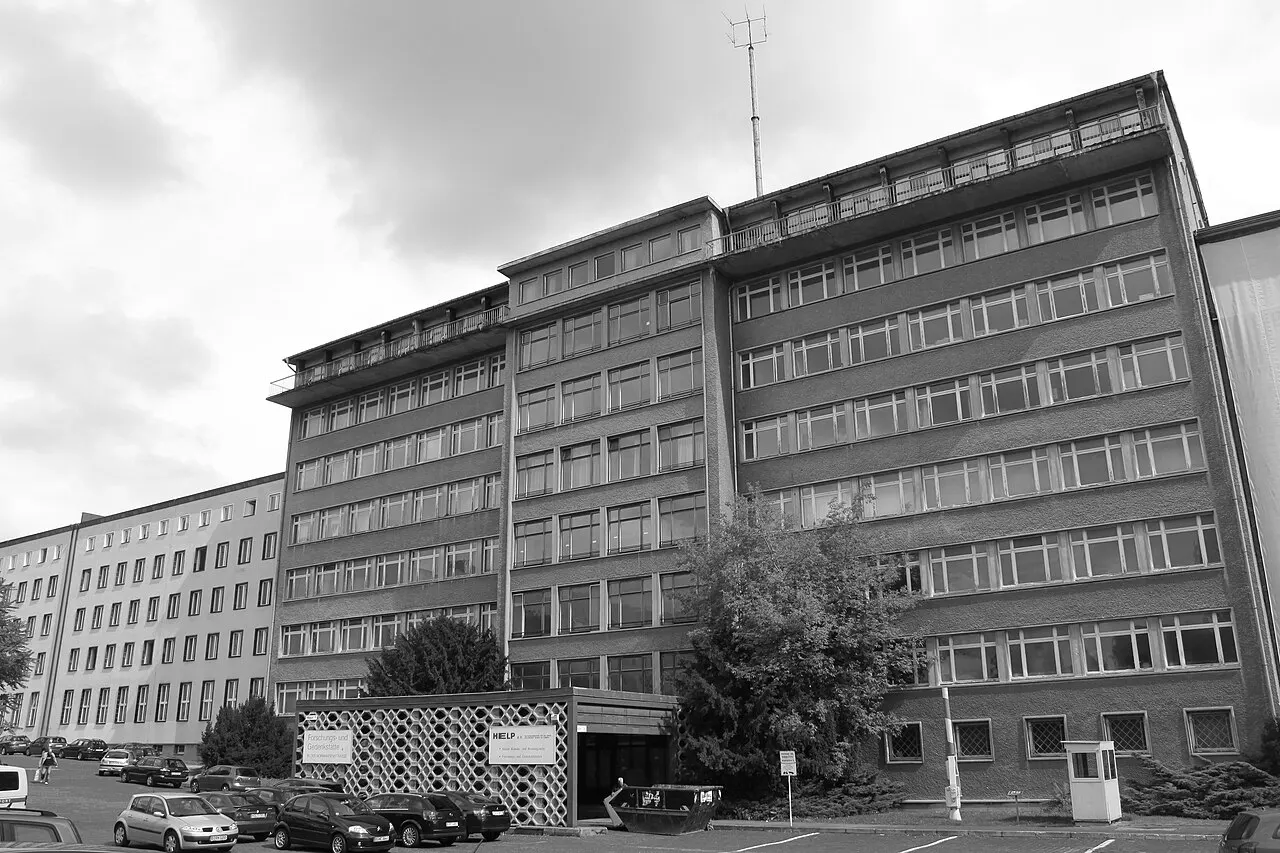
In the early evening of 15 January 1990, several thousand people gathered outside a huge office complex on Normannenstraße, in the Lichtenberg district of East Berlin. The gates opened, and the crowd poured in.
This was the headquarters of the Ministry for State Security, better known as the Stasi. For forty years it had watched, listened to and recorded the lives of East Germany’s citizens. Now those citizens were walking through its corridors.
They had come for one reason: to stop the files from being destroyed. For weeks, Stasi officers had been feeding documents into shredders and, when the machines could not keep up, tearing them apart by hand. What the protesters and the citizens’ committees saved that winter became one of the largest secret police archives ever opened to the public.
“Shield and sword of the party”
The Stasi was founded on 8 February 1950, a few months after the creation of the German Democratic Republic (GDR), the communist state in the Soviet zone of Germany. Its official motto described it as the “shield and sword” of the ruling Socialist Unity Party (SED).
It was both a foreign intelligence service and a secret political police. Its foreign arm, the HVA, ran spies in West Germany and NATO. But most of its effort went inward, toward its own population: anyone who might criticize the party, try to leave the country, attend the wrong church group, or simply have contact with the West.
From 1957 until November 1989, the ministry was run by Erich Mielke, a hard-line communist who had fled Germany in 1931 after the killing of two Berlin police officers. A German court convicted him for those killings in 1993.
A state inside the state
By 1989, the Stasi had about 91,000 full-time employees, in a country of roughly 16 million people. That made it, relative to population, one of the largest secret police forces in history.
But the full-time officers were only part of the system. The Stasi also relied on a vast network of unofficial collaborators, known by the German initials IM (Inoffizielle Mitarbeiter). These were ordinary people who agreed, secretly, to report on others: coworkers, neighbors, friends, church members, even their own families.
According to the Stasi Records Archive, by 1989 there were about 189,000 unofficial collaborators, or roughly one for every 90 citizens. Other counts, based on internal Stasi statistics, give a slightly lower figure of about 173,000 at the end of 1988. Either way, the number was enormous.
People became informers for many reasons. Some believed in the system. Some wanted a better job, a car, an apartment, or permission to travel. Others were pressured, threatened, or caught in a weak moment and offered a way out.
What the Stasi collected
The Stasi’s method was to know everything. Its officers opened mail, tapped telephones, planted microphones in apartments and followed people through the streets. They photographed visitors to church meetings and kept card indexes linking names, addresses and contacts.
Some of its methods have become symbols of the whole system. The International Spy Museum in Washington holds examples of the Stasi’s scent jars: cloths that had been in contact with a suspect, sealed in glass jars, so that trained dogs could later track the person. A scent sample could not be used as evidence in court, but it served as an investigative tool.
All of this produced paper on a staggering scale. Today, the Stasi Records Archive holds about 111 kilometers of files, about 69 miles of shelving, plus photographs, films and audio recordings. Around 51 kilometers came from the Stasi’s own central archives. About 60 more were taken, unsorted, from the officers’ desks and offices in 1990.
Zersetzung: breaking people without arrests
In its early decades, the Stasi often used open terror: arrests, long prison sentences and harsh interrogations. By the 1970s, East Germany wanted international recognition and better relations with the West. Mass arrests looked bad.
So the Stasi refined a quieter method called Zersetzung, a word usually translated as “decomposition” or “undermining.” It was formalized in Directive No. 1/76, issued in January 1976.
The goal was to destroy a target’s ability to act, without leaving obvious traces. Officers might spread rumors about a person, send anonymous letters, damage their reputation at work, block promotions, set friends against each other, or plant signs that someone had been inside their home. The victim often had no idea who was behind it, or whether they were imagining things.
Historians and German researchers estimate that several thousand people were targeted in this way. Many later reported lasting psychological harm.
The revolution reaches the files
In the autumn of 1989, mass protests spread across East Germany. On 9 November, the Berlin Wall opened. Mielke was out of office by mid-November. In a famous appearance before the East German parliament on 13 November 1989, he insisted he loved all people, and the chamber laughed at him.
Inside the Stasi, officers began destroying records. Citizens noticed smoke and shredding, and they moved to stop it. On 4 December 1989, according to the Stasi Records Archive, civil rights activists occupied the Stasi’s district office in Erfurt. Similar occupations followed in other cities, and citizens’ committees began guarding the buildings.
Berlin came last. The rally on 15 January 1990 had been called by the opposition movement New Forum, which asked people to stay non-violent. The guards did not resist. But by then, the Stasi had been destroying files for weeks.
The puzzle of the torn files
What the shredders and the tearing hands left behind was saved in bags and sacks. According to the DDR Museum in Berlin, about 15,000 containers of torn and shredded paper have been preserved.
Since the 1990s, archivists have been putting these pages back together, mostly by hand, piece by piece, like a giant jigsaw puzzle. More than 1.7 million sheets and index cards have been reconstructed so far. Computer-assisted methods have also been tested, but most of the containers remain unopened.
Opening the archive
After German reunification in October 1990, the question was what to do with the files. Some politicians, in both East and West, wanted them sealed or even destroyed, fearing they would trigger revenge, lawsuits and chaos.
East German activists pushed back. They argued that people had a right to know what had been done to them. The result was the Stasi Records Act, passed by the German parliament in December 1991. On 2 January 1992, the first citizens sat down to read their own files.
A special agency was created to manage the archive. It was first led by Joachim Gauck, an East German pastor and activist who later became President of Germany. For years, people simply called it the “Gauck Authority.” In June 2021, the files were transferred to the German Federal Archives, the Bundesarchiv, where they remain open to the public as the Stasi Records Archive.
Millions of requests have been filed since 1992. Britannica reports that nearly two million people had seen their own files by the early 21st century.
What people found
For many, reading the file was a shock. People learned that the Stasi had known about their friendships, love affairs, illnesses and private conversations. Code names in the reports could often be matched to real people, and the archive will tell a victim who their informers were, if the names can be identified.
The most painful discoveries were close to home. The East German dissident Vera Lengsfeld, arrested in 1988, learned after the archive opened that one of the informers reporting on her had been her own husband, Knud Wollenberger. The couple divorced. Years later, when he was seriously ill, she said she had forgiven him.
Writers have described the experience in famous books. The British historian Timothy Garton Ash, who had lived in East Berlin as a young researcher, read his own Stasi file and wrote The File (1997), tracking down the people who had reported on him. Anna Funder’s Stasiland (2003) collected the stories of victims and former officers.
The legacy
The Stasi files changed how countries deal with a dictatorship’s secrets. Germany chose to open the archive to victims, researchers and journalists, instead of sealing it. Other former communist states later created their own institutes to manage secret police files, with mixed results.
The files have also been used to vet public employees, to support rehabilitation and compensation claims, and to expose former informers in politics and public life. Some of these cases were bitterly disputed, because Stasi officers sometimes exaggerated or invented the value of their sources.
The former headquarters on Normannenstraße is now a museum and a center for the archive. Visitors can walk through Mielke’s preserved office, and see the rows of files that ordinary people once fought to save.
Myths and facts
| Claim | What the evidence says |
|---|---|
| The Stasi had one informer for every citizen | False. About 189,000 collaborators in 1989, roughly one in 90 people, according to the Stasi Records Archive. |
| Citizens stormed the Stasi headquarters to save the files | True. Thousands entered the Berlin headquarters on 15 January 1990, after occupations in Erfurt and other cities from December 1989. |
| The Stasi destroyed all its secrets before the fall | False. Much was destroyed, but about 111 km of files survived, and torn pages are still being reconstructed. |
| The Stasi collected people’s scents in jars | True. Scent samples were kept for tracking dogs. Examples are displayed in museums. |
| Victims can see who informed on them | True. Under the Stasi Records Act, people can read their files and ask for informers’ real names when they can be identified. |
| Every name in a Stasi file was a willing informer | False. Many files describe victims, contacts and people the Stasi tried and failed to recruit. Records must be read with care. |
Sources
- Bundesarchiv, Stasi Records Archive, accessed November 2026.
- Bundesarchiv, Stasi Records Archive, The Unofficial Collaborators of the MfS.
- Bundesarchiv, Stasi Records Archive, The Founding of the MfS.
- German History in Documents and Images (GHI Washington), Storming of the Stasi Headquarters (January 15, 1990).
- DDR Museum Berlin, From scraps of paper to mountains of files: the long aftermath of the Stasi files, 2016.
- International Spy Museum, Stasi Scent Jars.
- Encyclopaedia Britannica, Stasi Records Law.
- Ministry for State Security, Directive No. 1/76 on the Development and Revision of Operational Procedures, January 1976 (held in the Stasi Records Archive).
- Timothy Garton Ash, The File: A Personal History, Random House, 1997.
- Anna Funder, Stasiland, Granta, 2003.
- Gary Bruce, The Firm: The Inside Story of the Stasi, Oxford University Press, 2010.