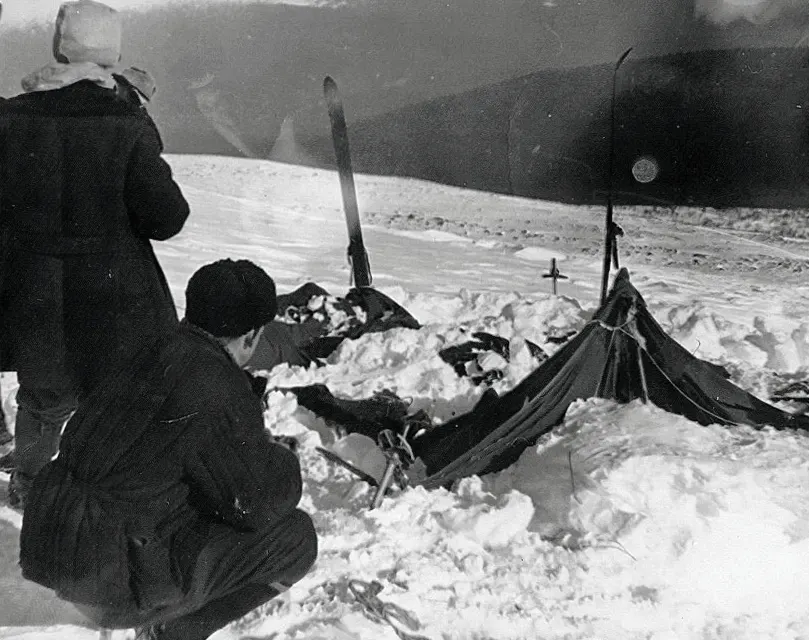
On February 26, 1959, a search party climbing the snowy slope of a mountain in the northern Ural Mountains found a tent. It was half buried in snow and badly damaged. Inside were boots, coats, food and equipment. There was no one in it.
Investigators later concluded that the tent had been cut open from the inside. In the snow below it, searchers found footprints left by people walking in socks, in a single shoe, or barefoot, in temperatures far below freezing. The tracks led down the slope toward the forest, more than a kilometer away.
The nine hikers who had slept in that tent were all dead. For more than sixty years, what drove them out into the night has been one of the most debated mysteries of the Soviet era. The official answer in 1959 was strangely vague: they had died because of a “compelling natural force.”
Ten students set out
The group came from the Ural Polytechnic Institute in Sverdlovsk (today Yekaterinburg). Its leader was Igor Dyatlov, a 23-year-old radio engineering student. Most of the others were students or recent graduates in their early twenties, all experienced in winter hiking and skiing.
The oldest member was Semyon Zolotaryov, 38, much older than the others and himself an experienced outdoorsman. The two women in the group were Zinaida Kolmogorova, 22, and Lyudmila Dubinina, 20.
Their goal was Otorten, a mountain about 10 kilometers north of where they would later die. The route was rated Category III, the most difficult level of Soviet sports hiking at the time. It meant long days on skis, heavy packs and nights in the cold.
The group left Sverdlovsk in late January 1959 and started the trek on skis from the last inhabited settlement on January 27. The next day, one member, Yuri Yudin, turned back because of health problems. He was the only one who survived. He died in 2013, aged 75.
The last camp
From the group’s diaries and photographs, investigators were able to follow their progress. On February 1, the nine hikers moved toward a pass but drifted west onto the slope of a mountain the local Mansi people call Kholat Syakhl, translated by some as “Death Mountain.”
They set up camp on the open slope. To do that, they dug into the snow to make a flat place for their tent.
Sometime that night, on February 1 or 2, something forced all nine of them out of the tent, most of them only partly dressed.
The search
The group was supposed to send a telegram after the trip, by around February 12. When nothing arrived, relatives grew worried. On February 20, the institute sent the first search teams, later joined by the army and the police.
On February 26, a student searcher, Mikhail Sharavin, found the tent. Over the following days, the bodies began to appear.
Near a large Siberian pine at the edge of the forest, about 1.5 kilometers from the tent, searchers found the remains of a small fire and the bodies of Yuri Doroshenko and Georgiy (Yuri) Krivonishenko. They were barefoot and dressed in their underwear. Branches of the tree had been broken off several meters up.
On the slope between the tree and the tent, they found Igor Dyatlov, Zinaida Kolmogorova and Rustem Slobodin, spaced hundreds of meters apart. Their positions suggested they had been trying to climb back toward the tent when they died.
All five had died of hypothermia. Slobodin had a small crack in his skull, but doctors did not think it was fatal.
The last four were not found until May 1959, after the snow began to melt. They lay under several meters of snow in a ravine near a stream, a short distance farther into the woods. Some of them were wearing clothing taken from their dead friends.
The injuries that started the legend
The bodies found in May are the reason the Dyatlov case never died.
According to the autopsy findings, Nikolai Thibeaux-Brignolles had a severe skull fracture. Lyudmila Dubinina and Semyon Zolotaryov had major chest fractures. One of the forensic doctors compared the force needed to a car crash. Yet there were no obvious external wounds to match. The fourth hiker in the ravine, Alexander Kolevatov, had died of hypothermia.
Some bodies were also missing soft tissue. Dubinina’s tongue and eyes were gone. Later writers have treated this as sinister. The forensic explanation given at the time, and accepted by most researchers today, is simpler: the bodies had lain for months in running water and snow, and the damage happened after death.
Tests also reportedly found traces of radioactivity on some of the clothing. This detail fed decades of theories about secret weapons. Another explanation has been offered: according to reporting cited by HISTORY, one hiker had lived in the area contaminated by the secret 1957 Kyshtym nuclear accident, and another had helped with the cleanup. No document has shown that the radiation had anything to do with the deaths.
“A compelling natural force”
The investigation in 1959 was led by Lev Ivanov, an investigator from the regional prosecutor’s office. Early on, suspicion fell on the local Mansi, an Indigenous people of the region. Several were questioned. But the only footprints around the tent belonged to the hikers, and there was no sign of a fight. The Mansi were cleared.
In May 1959, with no one to accuse, the inquest was closed. The official conclusion said the group died because of a “compelling natural force,” a phrase that explained nothing. The files were then placed in a restricted archive.
That secrecy, normal in the Soviet system, did enormous damage. For decades, the families and the public had only rumors. By the late 1980s, the files had become accessible in various ways, and journalists began to publish them. In 1990, Ivanov himself gave interviews saying there had been no rational explanation, and claimed he had been told to ignore reports of glowing spheres in the sky. His later statements have never been backed by any document.
The empty spaces in the story filled up quickly with theories: a missile or parachute-mine test, a nuclear accident, infrasound from the wind, escaped prisoners, KGB agents, a Yeti, and UFOs. The case inspired books, documentaries, a horror film and a video game.
The case reopens
In February 2019, at the request of relatives, Russia’s Prosecutor General’s Office announced a new inquiry. It said it would only consider natural causes. Officials named three possibilities: an avalanche, a slab avalanche or a hurricane-force wind. Murder had been ruled out.
On July 11, 2020, Andrei Kuryakov, a senior prosecutor in the Ural region, announced the conclusion: the group had been killed by an avalanche. He told reporters the injuries were typical of climbers caught in an avalanche, and called the hikers’ fight to survive “a heroic struggle.” He told the news agency RIA Novosti that they had fled the tent to avoid a possible avalanche, then became disoriented and froze.
The announcement did not end the debate. Many people who have studied the case, inside and outside Russia, remained unconvinced.
The science of a small avalanche
The biggest objection to the avalanche theory had always been the same. The 1959 searchers saw no obvious signs of an avalanche, and the slope above the tent was not very steep, less than 30 degrees.
In January 2021, two scientists in Switzerland, Johan Gaume of EPFL and Alexander Puzrin of ETH Zurich, published a study in the journal Communications Earth & Environment. Using models of snow, terrain and wind, they argued that a small slab avalanche could explain both the damage and the lack of evidence.
Their scenario works like this. To pitch their tent, the hikers cut into the snow-covered slope. That weakened the snow above. During the night, strong winds blowing down the mountain carried more snow onto the slope, slowly adding weight. Hours later, at least nine hours after the cut by their estimate, a slab of hardened snow broke loose and fell onto the tent.
A slab like that does not need to be large. Using computer simulations of the impact, the authors argued that it could still cause serious chest and skull injuries to people lying in the tent. And because it was small, its traces could have been covered by later snow before searchers arrived weeks later.
Puzrin summed it up plainly to EPFL: “If they hadn’t made a cut in the slope, nothing would have happened.”
The authors stressed that their work does not prove what happened. It shows that the avalanche explanation is physically possible. Other experts remain cautious. Slab avalanches usually happen on steeper slopes, and critics note that the hikers’ footprints showed no sign of running.
What is left of the mystery
Some questions will probably never be answered. Why did the group go so far down the mountain instead of staying near the tent? How did the most injured hikers end up in the ravine? Why did they not go back for their boots?
But the documents tell a story that is tragic rather than supernatural: nine experienced young people, a mistake in where they camped, a storm in the dark in deep winter cold, and a desperate decision made in seconds. The Soviet habit of secrecy turned that tragedy into a legend.
Today, the place where they died is officially called Dyatlov Pass, after the young man who led them.
Myths and facts
| Claim | What the evidence says |
|---|---|
| The tent was cut open from the inside | True. This was the finding of the 1959 investigators. |
| The hikers fled without boots or warm clothes | True. Footprints showed people in socks, one shoe or barefoot. |
| Most of the hikers were killed by violence | False. Six of the nine died of hypothermia. Three had severe injuries. |
| The Soviet investigation concluded with a clear cause | False. It closed in May 1959 citing only a “compelling natural force.” |
| Radiation on clothing proves a secret weapon test | Unproven. Traces were reportedly found, but no document links them to the deaths. |
| Russia now officially blames an avalanche | True. Prosecutors announced this conclusion in July 2020. It is still debated. |
| Science has shown a small avalanche was possible | True. A 2021 peer-reviewed study modeled it, without claiming certainty. |
Sources
- Johan Gaume and Alexander Puzrin, Mechanisms of slab avalanche release and impact in the Dyatlov Pass incident in 1959, Communications Earth & Environment, January 2021.
- EPFL, Using science to explore a 60-year-old Russian mystery, January 28, 2021.
- TASS, Prosecutors say avalanche killed Dyatlov group in Urals in 1959, July 11, 2020.
- Radio Free Europe/Radio Liberty, Russian officials reportedly close investigation into mysterious 1959 hiking disaster, July 2020.
- Becky Little, The Dyatlov Pass Incident: Why the Hiker Deaths Remain a Mystery, HISTORY, 2024.
- Donnie Eichar, Dead Mountain: The Untold True Story of the Dyatlov Pass Incident, Chronicle Books, 2013.