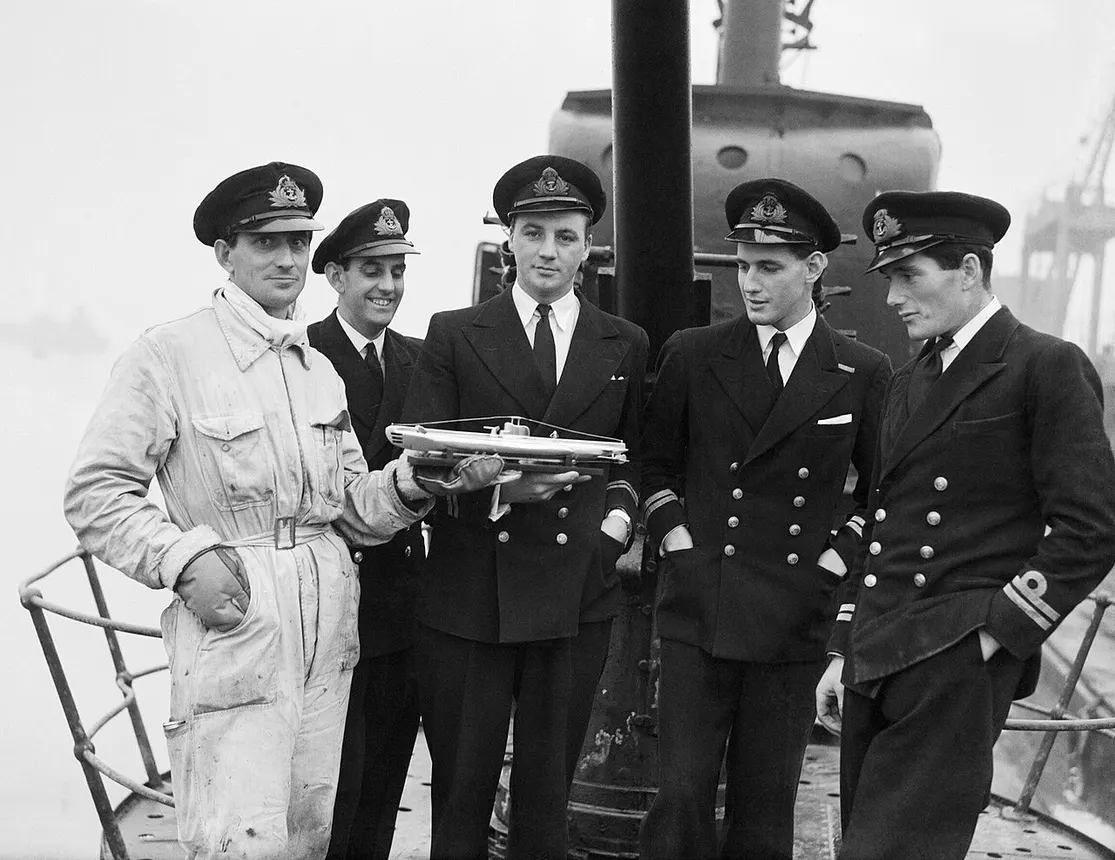
At about 4:15 in the morning on 30 April 1943, a British submarine surfaced in the dark off the coast of southern Spain, near the port of Huelva. The officers brought a long steel canister up on deck and sent the rest of the crew below. They had been told it held a secret weather instrument.
It did not. Inside was the body of a man in the uniform of a Royal Marines officer, with a briefcase chained to his coat. The officers lowered him into the sea, the captain read a psalm, and the submarine’s engines pushed the body toward the shore.
A few hours later, a Spanish fisherman found “Major William Martin” floating in the water. Within two weeks, the letters in his briefcase were in German hands. And Adolf Hitler believed them.
The man had never been Major Martin. He had never been a soldier at all. The operation was called Mincemeat, and it became one of the most famous deceptions of the Second World War.
The problem: Sicily was too obvious
By early 1943, the Allies were winning in North Africa. At the Casablanca Conference in January, Allied leaders chose their next target: the Italian island of Sicily, codenamed Operation Husky, to be invaded no later than July.
The trouble was that everyone could see it coming. Sicily sat between North Africa and Italy. Churchill is reputed to have said that only a fool would not guess it. The Allies needed the Germans to look somewhere else.
They knew where Hitler was already looking. He feared an Allied landing in Greece and the Balkans, a region that supplied Germany with oil, copper, chrome and bauxite. So the British built a wider deception, Operation Barclay, to feed that fear: a fake “Twelfth Army” headquarters in Cairo, dummy tanks in Syria, Greek maps and Greek interpreters.
Mincemeat was meant to put the final proof directly into the enemy’s hands.
An idea from a “Trout memo”
The idea was not new. In September 1939, the Director of Naval Intelligence, Rear Admiral John Godfrey, circulated a list of deception ideas known as the Trout memo. Historians believe much of it was written by his assistant, a young officer named Ian Fleming, who would later create James Bond.
Item 28 on the list suggested planting misleading papers on a corpse that the enemy would find. Its own title admitted it was “not a very nice one.”
In late 1942, an RAF officer working for MI5, Charles Cholmondeley, revived the idea. He was teamed with Ewen Montagu, a lawyer serving in Naval Intelligence. Together, they turned it into a detailed plan.
Finding a body
They needed a dead man who looked as if he had drowned after a plane crash at sea, and who had no family to claim him. The famous pathologist Sir Bernard Spilsbury told them that a Spanish post-mortem was unlikely to tell the difference, especially after days in the water.
The London coroner Bentley Purchase agreed to look for a suitable body. In January 1943, he found one: Glyndwr Michael, a homeless Welshman from Aberbargoed, in Monmouthshire. He had died in a London hospital after swallowing rat poison containing phosphorus. His parents were dead, and no one came forward for him.
The body was kept in a mortuary refrigerator. Purchase warned that it had to be used within about three months.
For decades, the man’s real name stayed secret. Montagu would only say he had been “a bit of a ne’er-do-well.” In 1996, an amateur historian named Roger Morgan found evidence in the British archives that the body was Glyndwr Michael’s.
Inventing Major William Martin
Next, Montagu and Cholmondeley created a person. They called him Captain (Acting Major) William Martin, Royal Marines, attached to Combined Operations Headquarters. “Martin” was a common name in the Marines, and Royal Marines came under the Admiralty, so any official questions would come back to Naval Intelligence.
Then they filled his pockets with what spies call “pocket litter,” the small details of a real life:
- A photograph of his fiancée, “Pam.” The picture was really of an MI5 clerk, Jean Leslie.
- Two love letters from Pam, and a receipt for a diamond engagement ring from a Bond Street shop.
- A stern letter from his father, and a letter from Lloyds Bank about an overdraft.
- Theater ticket stubs and a bill from the Naval and Military Club in London, which placed him in the city in the days before his “flight.”
The photograph for his identity card came from an MI5 officer, Captain Ronnie Reed, who looked like the dead man. Montagu rubbed the cards on his trousers for weeks so they would look worn.
The fake secret letters
The heart of the plan was a personal letter from Lieutenant General Sir Archibald Nye, the Vice Chief of the Imperial General Staff, to General Sir Harold Alexander, a senior Allied commander in North Africa. After drafts by others sounded unnatural, Nye wrote it himself.
The letter discussed planned landings in Greece, at Cape Araxos and Kalamata, and described Sicily as a mere “cover target.” A second letter, from Lord Louis Mountbatten, contained a weak joke about sardines that Montagu hoped the Germans would read as a hint about Sardinia.
To make sure the letters would not be missed, they went into an official briefcase, chained to Martin’s belt. The planners also hid a single eyelash inside one letter, so they could later tell whether it had been opened.
Churchill says yes
On 15 April 1943, Colonel John Bevan, head of the London Controlling Section, which coordinated British deception, explained the plan to Winston Churchill. Bevan warned that the Spanish might simply hand the body back with the papers unread.
According to the accounts of the meeting, Churchill answered that they would then have to “give it another swim.” He approved the plan and left the final word to General Dwight D. Eisenhower, the Allied commander in the Mediterranean. Eisenhower’s approval arrived on 17 April.
The voyage
Early on 17 April, the body was dressed, packed into a steel canister filled with dry ice, and driven overnight to Scotland. There it was loaded onto the submarine HMS Seraph, commanded by Lieutenant Bill Jewell.
Seraph sailed on 19 April and reached the waters off Huelva on 29 April. Huelva had been chosen with care: the tides would carry a body ashore, and a well-connected German agent, Adolf Clauss of the Abwehr, Germany’s military intelligence service, worked in the town.
After the body was released, Jewell signaled London: “Mincemeat completed.”
What Spain did with the briefcase
The fisherman’s discovery set everything in motion. On 1 May, two Spanish doctors carried out a brief post-mortem in the presence of the British vice-consul, Francis Haselden, and recorded death by drowning at sea. Major Martin was buried in Huelva on 2 May with military honors.
Meanwhile, the British sent coded cables asking urgently for the briefcase back. They knew the Germans could read this code, and the cables were written to make the briefcase look important.
Spain was officially neutral, but its government was friendly to Germany. The Spanish Navy kept the briefcase. At German request, the letters were carefully pulled out of their sealed envelopes, dried, photographed and put back. The information reached the Germans on 8 May. On 11 May, the briefcase was returned to the British.
In London, experts found that the eyelash was gone and that the paper had been folded more than once. The letters had been read.
“Swallowed rod, line and sinker”
The final proof came from Bletchley Park, the British codebreaking center. On 14 May, it decrypted a German message warning that the Allied attack would come in the Balkans.
A message was sent to Churchill, who was then in the United States: “Mincemeat swallowed rod, line and sinker.”
On the same day, Grand Admiral Karl Dönitz met Hitler. Dönitz recorded that Hitler believed the captured “Anglo-Saxon order” confirmed attacks would target Sardinia and the Peloponnese, in Greece. Hitler ordered the 1st Panzer Division moved from France to Greece. German forces on Sardinia were doubled, and torpedo boats were moved from Sicily to the Greek islands.
Did it work?
The Allies invaded Sicily on the night of 9 to 10 July 1943. According to intercepted German signals, even hours after the landings began, German aircraft were still leaving Sicily to reinforce Sardinia.
The campaign ended on 17 August, after 38 days. Historian Ben Macintyre notes that the planners had expected 90. He also reports that casualties in the first week were about a seventh of what British planners had feared.
Historians are careful about how much credit to give. The military historian Michael Howard called Mincemeat perhaps the most successful single deception of the war, but argued that Hitler’s existing obsession with the Balkans mattered more. The exact effect cannot be measured.
The man who never was
The story came out sooner than British security wanted. In 1950, former cabinet minister Duff Cooper, who had been briefed on the operation, published a novel, Operation Heartbreak, with a very similar plot. The government decided it was better to tell the story itself. In 1953, Ewen Montagu published The Man Who Never Was, which became a 1956 film. He did not reveal the role of codebreaking.
Today the grave in Huelva still carries the name of Major William Martin. The Commonwealth War Graves Commission took responsibility for it in 1977, and in the late 1990s it added a line recognizing that Glyndwr Michael “served as Major William Martin RM.” A homeless man who died alone in London is remembered, at last, under both names.
Myths and facts
| Claim | What the evidence says |
|---|---|
| A dead body was used to trick the Germans | True. The operation is documented in British records and confirmed by German messages decrypted at Bletchley Park. |
| Ian Fleming invented the whole operation | Partly true. The idea appeared in the 1939 Trout memo linked to Fleming, but Cholmondeley and Montagu planned and ran Mincemeat. |
| The Germans opened the letters | True. A planted eyelash was missing and the paper showed extra folds when the briefcase came back. |
| Hitler moved troops because of the letters | True. He ordered the 1st Panzer Division to Greece and reinforced Sardinia. |
| Mincemeat single-handedly won the Sicily campaign | False. Historians credit it as one factor among several. |
| The identity of the body is completely certain | Mostly settled. Official records point to Glyndwr Michael, but some authors have suggested other men. |
Sources
- Commonwealth War Graves Commission, The Man Who Never Was – The True Story of Operation Mincemeat, April 2022.
- Commonwealth War Graves Commission, casualty record for Glyndwr Michael, Huelva Roman Catholic Cemetery, Spain.
- The National Archives (UK), Operation Mincemeat files, including WO 106/5921 and CAB 154/112.
- Ewen Montagu, The Man Who Never Was, Evans Brothers, 1953.
- Ben Macintyre, Operation Mincemeat: The True Spy Story that Changed the Course of World War II, Bloomsbury, 2010.
- Denis Smyth, Deathly Deception: The Real Story of Operation Mincemeat, Oxford University Press, 2010.
- Michael Howard, Strategic Deception in the Second World War, HMSO, 1990.